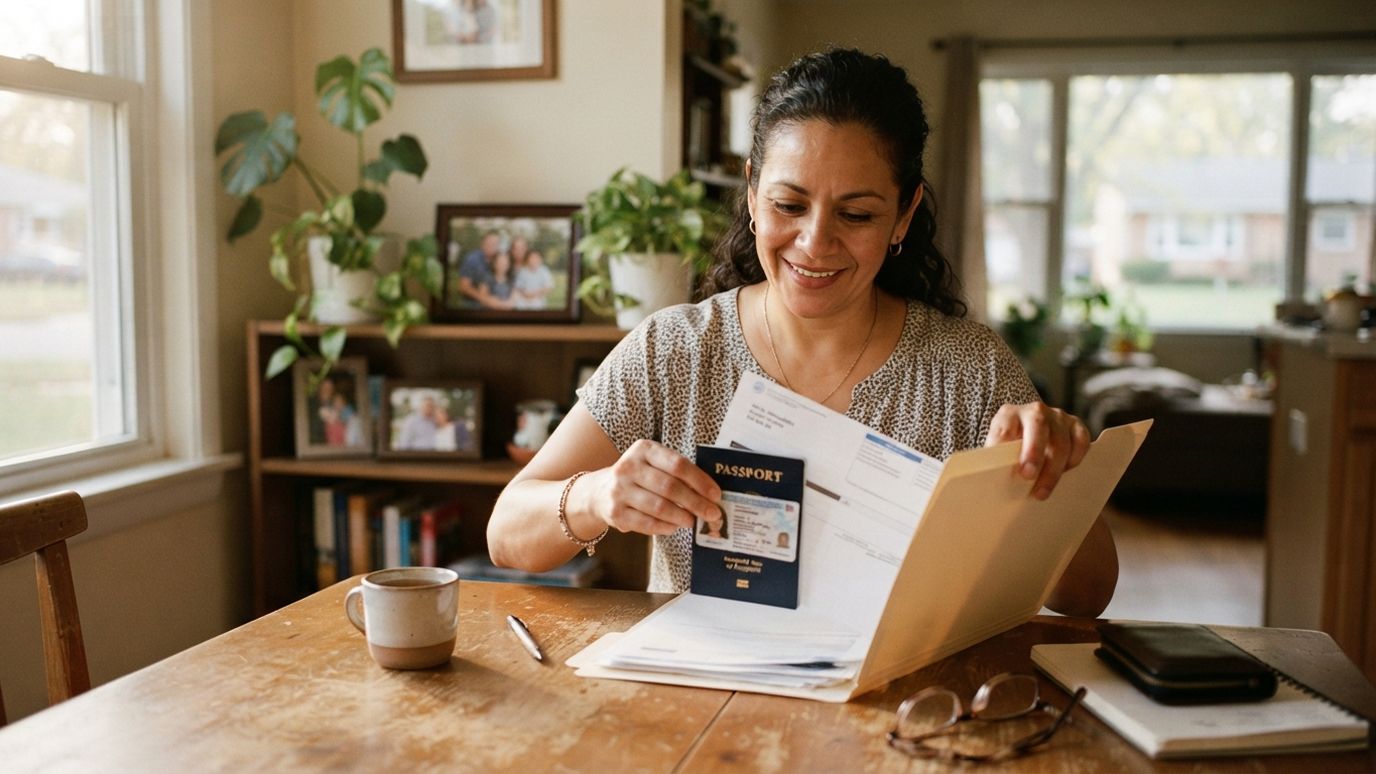
- Checklist: what to bring to the bank
- Why banks ask for these documents
- Proof of address: where most applications fail
- Your name must match on every document
- When the problem is not your documents: ChexSystems
- Checking or savings: which account to ask for
- What to ask before you sign
- What to do if a document is rejected
- After the account is open
- Frequently asked questions
- Official sources
Quick answer To open a checking or savings account in the US you usually need four things: a government-issued photo ID (driver’s license, state ID or passport), an identification number (your SSN, or an ITIN if you do not have one), proof of your US address (a recent utility bill, lease or bank statement in your name) and, at some banks, a small opening deposit. If you are not a US citizen and have neither an SSN nor an ITIN, federal rules also allow a bank to accept your passport number, an alien ID card number or another government photo ID that shows your nationality or residence, but each bank decides what it will take.

Checklist: what to bring to the bank
| Document | What usually works | If you do not have it |
|---|---|---|
| Photo ID | Driver’s license, state ID, US passport, green card, work permit (EAD) | Your foreign passport. Some banks also accept a consular ID (matrícula consular) or a national ID such as El Salvador’s DUI. |
| Second ID (some banks) | Debit or credit card, birth certificate, student or employee ID, Social Security card | Ask which secondary documents the branch accepts before your visit. |
| Identification number | Social Security number (SSN) | An ITIN. Without either, a passport number or another government ID number, if the bank allows it. See how to open an account without an SSN. |
| Proof of address | Utility bill, lease, insurance statement or bank statement from the last 60 to 90 days, in your name | A letter from your employer or landlord, or a recent piece of official mail. Ask the bank first; this is the document that fails most often. |
| Opening deposit | Cash, a check or a transfer; often $25 to $100, sometimes $0 | Look for an account with no minimum opening deposit. |
| Date of birth and phone or email | Written on the application | Needed for online banking and security alerts. |
Requirements vary by bank and sometimes by branch. A quick call before your appointment (“Which IDs do you accept for someone without a Social Security number?”) saves you a second trip.
Why banks ask for these documents
Every US bank and credit union must run a Customer Identification Program (CIP) under federal anti-money-laundering rules. Before opening an account, it has to collect at least your name, date of birth, address and an identification number. For a US person that number is a taxpayer ID, normally the SSN. For a non-US person the rule lists several options: a taxpayer ID such as the ITIN, a passport number and country of issuance, an alien identification card number, or the number of another government-issued photo document showing nationality or residence. The rule even lets banks open an account while an ITIN application is pending.
That is why “we need a Social Security number” is a bank’s policy, not the law. If one bank says no, another may say yes with the same documents.
Proof of address: where most applications fail
The document must be recent, in your name and show your full address. The problem usually starts when you rent a room or share housing and no bill is in your name. Options that often work: a lease or sublease signed by the owner, a letter from your employer on company letterhead, a recent statement from an insurer or phone carrier, or official mail from a government agency. If the address on your ID is different, bring something recent that shows the current one.
Your name must match on every document
This trips up many Hispanic applicants for no real reason. If your passport shows two last names and your lease shows one, or one document has a middle name and another does not, the system may read them as two different people. Before your appointment, check that your name is written the same way on your ID, your ITIN letter and your proof of address, or bring a document that shows both versions.
When the problem is not your documents: ChexSystems
Banks also check a checking account screening report, most often from ChexSystems. It records unpaid overdrafts, accounts closed by a bank and suspected fraud. If you are denied because of that report, the bank must give you an adverse action notice naming the company, and you can request a free copy and dispute errors. You are also entitled to one free report every 12 months. If the report is accurate, ask about a “second chance” or checkless account, which many banks and credit unions offer.
Checking or savings: which account to ask for
A checking account is for everyday money: direct deposit of your paycheck, a debit card, bill payments. A savings account is for money you want to keep; it pays interest, shown as the APY (annual percentage yield), and may limit withdrawals. Most people start with a checking account and add savings at the same bank. Whichever you choose, confirm the institution is insured: the FDIC covers bank deposits and the NCUA covers credit unions, up to $250,000 per depositor, per institution, per ownership category.
What to ask before you sign
- Is there a monthly fee, and exactly what waives it (direct deposit, minimum balance, age)?
- What is the minimum opening deposit, and do I have to keep it in the account?
- What are the overdraft fees, and can I turn overdraft coverage off?
- Are there fees for out-of-network ATMs or for receiving international transfers?
- Can I get statements and customer service in Spanish?
If the answers are not good, compare with accounts with no monthly fee or with a credit union, which is often more flexible with first-time customers.
What to do if a document is rejected
A no at the counter is rarely final. Ask for the exact reason and which alternative document the bank would accept. The three usual fixes: bring a recent document showing your current address; bring a second ID that shows your full name; or, if the bank requires an SSN or ITIN you do not have, try another bank or a credit union that uses the options the federal rule allows. If you still need an ITIN, our guide to what the ITIN is and how to apply walks through Form W-7.
After the account is open
Set up direct deposit, which often removes the monthly fee and creates a record of regular income. Keep the balance positive: overdraft fees are among the most expensive charges in US banking, and an unpaid negative balance ends up on your ChexSystems report. Turn on text alerts, and learn how to avoid overdraft fees before you need to. A checking account does not build credit by itself, but it is usually the first step toward a secured credit card at the same bank.
Frequently asked questions
Can I open a bank account with only a passport?
Sometimes. Federal rules allow a bank to identify a non-US person by passport number and country of issuance, but many banks also want an SSN or ITIN and proof of a US address. Ask the bank directly, or start with a credit union.
Do banks accept the matrícula consular?
Some do. For example, Wells Fargo’s published ID list for Everyday Checking includes consular cards from Colombia, Guatemala and Mexico and El Salvador’s DUI (checked September 28, 2026). Policies differ between banks, so confirm before you go.
How much money do I need to open a checking account?
It depends on the account. Many accounts require $25 to $100 to open and some require nothing. Check whether you must keep a minimum balance afterwards to avoid a monthly fee.
Can I open an account online?
If you have an SSN, usually yes. Without one, online applications often fail because the SSN field is required, even at banks that would open the account in a branch with an ITIN or passport. Some online banks accept an ITIN; read their requirements before uploading documents.
Last reviewed September 28, 2026, against the federal Customer Identification Program rule (31 CFR 1020.220), CFPB guidance on checking account denials and FDIC deposit insurance rules. Bank requirements change; always confirm with the bank.
Related articles
Official sources
To check what this guide explains, these are the official references. If a rule changes, the official version always prevails.
- 31 CFR 1020.220: Customer Identification Program for banks: the identifying information banks must collect and the options for non-US persons
- CFPB: why was I denied a checking account?: screening reports, your rights and alternatives
- CFPB: Chex Systems, Inc.: how to request your free report and dispute errors
- FDIC: deposit insurance: which accounts are insured and up to what amount
